
constructionequipmentmag.com
05
'26
Written on Modified on
Liebherr LTM 1650-8.1 crane dismantles historic German arch bridge
MSG Krandienst utilized specialized outriggers and VarioBallast technology to operate in a highly constrained riverside workspace.
www.liebherr.com
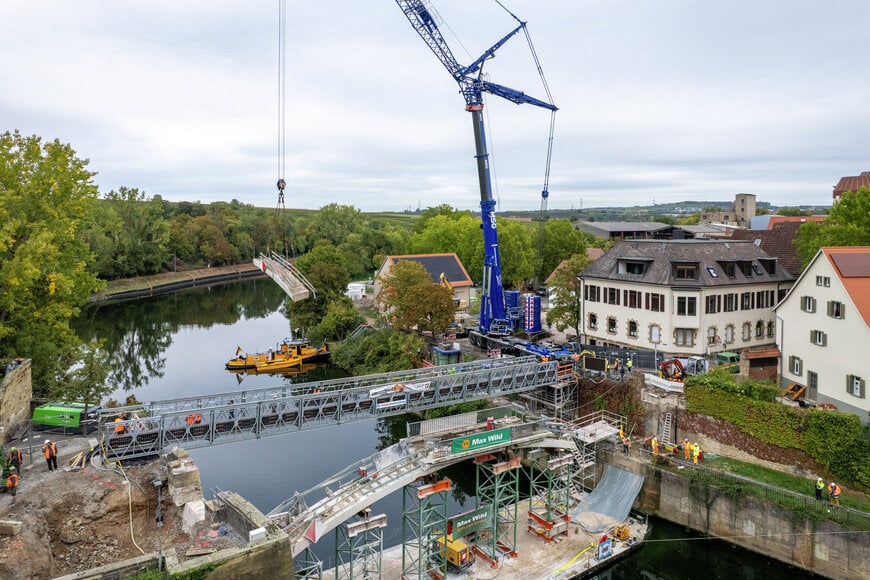
A Liebherr LTM 1650-8.1 mobile crane, operated by MSG Krandienst GmbH, was recently deployed to completely dismantle a dilapidated 1951 arch bridge in Lauffen am Neckar, Baden-Württemberg. The river crossing, connecting a densely built-up old town across a canal to a small island, presented significant logistical challenges due to the severe lack of available installation space at the water's edge. The project highlights the sophisticated engineering and compact lifting solutions required to replace aging infrastructure in tightly confined urban topographies.
Custom outrigger engineering and extended reach
To overcome the narrow installation area, the lifting crew had to engineer a highly unconventional stabilization setup. "The topography on site severely restricted our options for setting up the mobile crane," explained Christian Spreuer, project planning engineer at MSG Krandienst. The team positioned the river-side outriggers entirely outside the primary installation plane. This required extending two support cylinders over the riverbank and securing them to massive steel cylinders that rested on concrete foundations situated approximately four meters lower than the road level. An auxiliary cylinder under the rear of the eight-axle vehicle further facilitated assembly on the sloping terrain. Configured with a 35-meter luffing jib and loaded with 175 tonnes of counterweight, the crane was able to safely hoist construction machinery across the 40-meter-wide canal to the island at a maximum reach of 50 meters.
Segmented demolition and VarioBallast capabilities
Prior to the main demolition, the 700-tonne class crane installed a temporary footbridge. The old bridge superstructure was then removed section by section, and the massive supporting arch was cut into five segments using heavy-duty concrete saws. During this critical phase, a specialized pontoon equipped with scaffolding piers and a pump-adjustable flooding system supported the arch from below. The heaviest single lift of the multi-day operation was the 44-tonne apex section of the arch, handled at a radius of over 36 meters. Throughout the project, the LTM 1650-8.1 utilized Liebherr's VarioBallast® system, allowing operators to continuously adjust the crane's ballast radius to efficiently manage dynamic load conditions and shifting reaches spanning from 26 to 50 meters.
Additional Context: Outrigger ground bearing pressure and variable ballast kinematics
This section details the physical forces and mechanical principles of heavy mobile cranes not included in the original press release.
In heavy mobile crane operations, particularly near riverbanks, embankments, or retaining walls, managing ground bearing pressure is critical. A crane lifting a 44-tonne load at a 36-meter radius generates immense, asymmetric point loads through its outrigger pads. If positioned too close to an embankment without proper load distribution, this intense pressure can exceed the soil's shear strength, causing a localized rotational landslide and catastrophic crane tip-over. By engineering custom steel cylinders anchored to lower concrete foundations, the MSG Krandienst team effectively bypassed the unstable upper soil layers, transferring the compressive forces directly into a competent load-bearing substrate.
Furthermore, maximizing lifting capacity on a physically constrained footprint relies heavily on manipulating the crane's center of gravity. Traditional heavy-duty cranes utilize a fixed counterweight radius, which requires a massive swing clearance area behind the machine. Liebherr's VarioBallast® system solves this spatial conflict by using robust hydraulic slewing cylinders to dynamically alter the distance between the counterweight stack and the crane's rotational axis. By extending the ballast radius outward, the crane maximizes its load moment (its resistance to tipping), enabling extremely heavy, distant lifts like the arch apex. Conversely, by retracting the radius, the crane can operate safely within confined spaces without the tail swing striking nearby structures or traffic.
Edited by an industrial journalist, Lekshman Ramdas, with AI assistance.
www.liebherr.com
