
constructionequipmentmag.com
20
'26
Written on Modified on
Heavy-lift crawler crane assembles 365-meter high-altitude wind tower
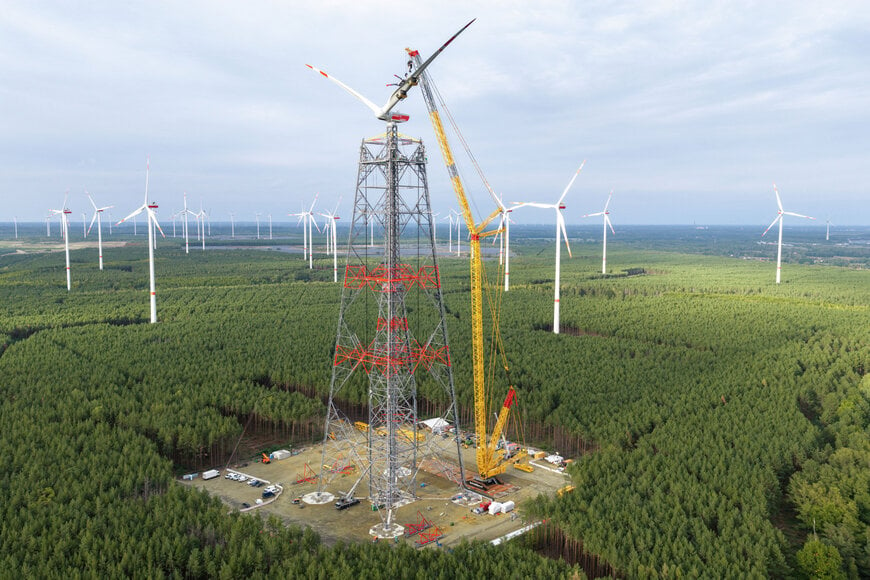
Schmidbauer GmbH & Co. KG used a crawler crane from Liebherr-Werk Ehingen GmbH to erect a high-altitude wind turbine for the Gicon Group in Brandenburg.
www.liebherr.com
Application areas: Heavy-lift assembly, onshore wind energy, crane logistics.
Industry sectors: Renewable energy, plant engineering, heavy-lift transport.
The economic utilization of onshore wind energy increasingly requires turbines that reach into high altitudes to harness stronger and more consistent air currents for power generation. For this purpose, Gicon-Großmann Ingenieur Consult GmbH from Dresden developed a high-altitude wind tower for a 3.8-megawatt wind turbine with a rotor diameter of 126 meters in the Lusatia region of Brandenburg. The main challenge in erecting this prototype consisted of precisely lifting large-scale steel lattice segments with individual weights of up to 375 metric tons and safely achieving an overall structural height of 365 meters.
Technical configuration for extreme load capacities and lifting heights
To meet the high demands for load capacity and lifting height within an existing wind farm, the crane service provider Schmidbauer GmbH & Co. KG deployed an LR 11350 crawler crane manufactured by Liebherr-Werk Ehingen GmbH. The decisive factor in selecting this crane system was its modular boom concept combined with a total ballast of up to 850 metric tons on the crane and on the ballast pallet of the derrick boom. Until reaching the preliminary tower height of around 160 meters, the crane was configured with a parallel boom system and a luffing jib of up to 84 meters in length. This design significantly increases lateral stability and load capacity, which was strictly required for assembling the heaviest tower segment measuring around 40 by 40 by 40 meters with a gross weight of 375 metric tons. At an outreach of 44 meters, the crawler crane placed this load onto the 50-meter-high base structure. Because the crane had to travel while carrying the load, a load-bearing access road made of steel plates and bongossi timbers was constructed on the sandy ground. Parallel to the outer structure, the upper tower section, which would later be telescoped, was fabricated inside, while additional mobile cranes supported the pre-assembly of the lattice mast segments and the rigging process.
Rapid reconfiguration and precise final assembly
For the final installation of the rotor blades at a height of around 170 meters, an adjustment of the crane architecture was necessary. Thanks to the well-engineered rigging concept of the crawler crane, the conversion from the parallel boom to a 104-meter-long lattice boom in combination with the 84-meter luffing jib was completed within six days. This allowed the system to reach a pulley head height of 200 meters. During a suitable weather window with low wind speeds, the assembly teams installed all three rotor blades within twelve hours. Immediately afterward, the inner tower of the lattice structure was telescoped upward to its final height of 365 meters via an integrated system.
Throughout the entire deployment period of around 18 months, the high system availability of the crawler crane ensured a construction process free of delays. Following the completion of the assembly work, crane operator Fabian Ueck confirmed that the LR 11350 operated reliably and without malfunctions throughout the entire duration of the project.
Edited by Sucithra Mani, Induportals editor – adapted by AI.
www.liebherr.com
