
constructionequipmentmag.com
20
'26
Written on Modified on
Pick-and-Carry Timber Handler for Sawmill Log Yards
SENNEBOGEN 724 G resolves heavy roundwood transport and sorting bottlenecks at Holzhof Schmidt through dual-circuit hydraulics and rearward boom kinematics.
www.sennebogen.com
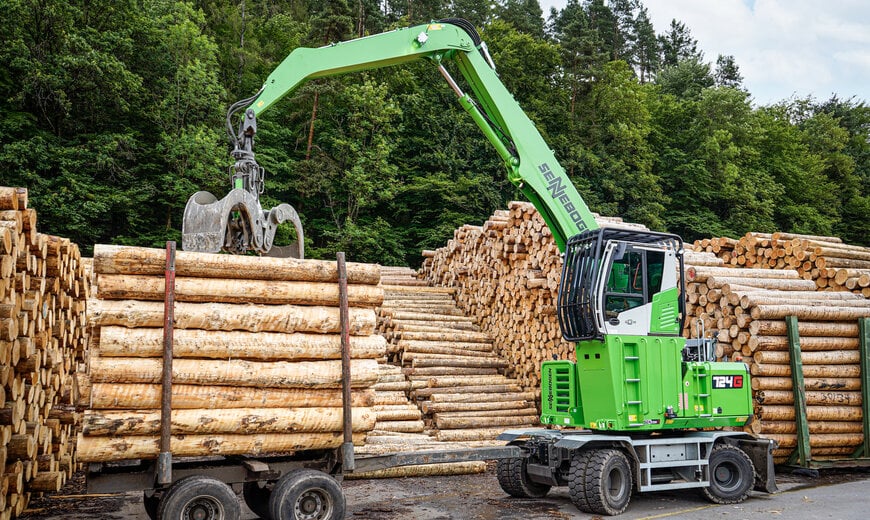
High-volume sawmills face severe internal logistics bottlenecks when moving heavy timber across expansive, uneven log yards while maintaining continuous mill feeding. To address these operational demands, Lower Austrian sawmill Holzhof Schmidt is conducting multi-shift field testing of the SENNEBOGEN 724 G mobile pick-and-carry timber handling machine alongside its existing fleet of SENNEBOGEN 730 E units.
Log Yard Logistics and Material Flow Challenges in Timber Processing
In industrial timber processing, overall plant throughput depends heavily on uninterrupted material flow from the roundwood yard to the sorting and cutting lines. At Holzhof Schmidt, which processes approximately 100,000 solid cubic meters of spruce, pine, and larch annually, internal transport equipment must operate across a long, topographically challenging yard featuring inclines and ramps.
Machines deployed in these environments must perform multiple mechanical tasks simultaneously: grabbing, stacking, sorting, and towing heavily loaded trailers over extended distances. Conventional single-circuit hydraulic architectures often suffer from power drops when an operator attempts to travel under heavy tractive load while actuating the upper carriage or boom, directly increasing cycle times and fuel consumption.
Dual-Circuit Hydraulic Architecture and Tractive Performance
The transition from the SENNEBOGEN E-Series to the G-Series introduces fundamental mechanical and hydraulic changes designed to eliminate power distribution bottlenecks during pick-and-carry operations. The core engineering update in the SENNEBOGEN 724 G is a dual-circuit travel drive paired with two separate hydraulic pump systems—one dedicated to the travel drive and another to the upper carriage.
By decoupling the propulsion hydraulics from the working hydraulics, the machine maintains consistent hydraulic pressure and flow during simultaneous travel and material handling. Operators can travel across the yard, tow a loaded roundwood trailer up ramps, and actuate the sorting grapple or slew the upper carriage without experiencing hydraulic lag or speed reduction. In continuous multi-shift testing at Holzhof Schmidt, this architecture has resulted in shorter cycle times, increased agility, and lower fuel consumption compared to predecessor models. Despite being a more compact machine class, the tractive force generated by the 724 G drivetrain approaches the pulling performance of the larger 730 E class.
"What I like most about the concept of the new 724 G are the two separate pump systems for the travel drive and the upper carriage. This separation provides noticeably more overall power when you are driving and handling material at the same time," says Christian Kronaus, who oversees the sorting line and sawmill feeding at Holzhof Schmidt.
Structural Kinematics and Load Stability
Handling dense softwood and hardwood logs at reach while mobile requires careful center-of-gravity management to prevent tipping and reduce structural stress on the slewing ring. In the 724 G design, engineers repositioned the boom pivot point further toward the rear of the upper carriage.
Shifting the boom pivot rearward optimizes the machine's weight distribution and effectively shortens the unfavorable lever arm when lifting heavy loads. This kinematic adjustment increases static and dynamic stability during pick-and-carry sorting and trailer loading, allowing operators to maneuver heavy roundwood across uneven yard surfaces with a higher safety margin.
"We are specifically testing the new 724 G-Series at Holzhof Schmidt in multi-shift and trailer operations under real, harsh conditions. For us as a manufacturer, the extremely close contact and the regular, bi-weekly feedback from drivers and maintenance staff are worth their weight in gold, allowing us to feed this feedback directly back into the factory," explains Mario Urmann, Product Specialist at SENNEBOGEN.
Control Systems, Operator Ergonomics, and Ground-Level Maintenance
Because medium- and large-scale sawmills operate across multiple shifts with rotating personnel, machine adaptability and preventive maintenance access directly impact equipment availability. The SENNEBOGEN 724 G integrates the SENCON control system, which enables individual operators to configure and save personalized machine profiles via a touch display. Drivers can adjust parameters including travel speed, slewing gear responsiveness, and upper carriage slewing performance to match specific tasks such as precision sorting versus rapid trailer unloading.
To mitigate occupational health hazards in high-particulate sawmill environments, the operator cab features specialized sealing to keep the interior free of wood dust, paired with climate control and seat ventilation to reduce operator fatigue during long shifts.
For daily servicing and inspection routines, the G-Series layout consolidates maintenance points for ground-level access. All filtration components are accessible from the side of the machine, and fluid level sight glasses and checkpoints can be inspected directly from the ground. Eliminating the need for operators or technicians to climb onto the upper structure during routine daily checks reduces slip-and-fall risks and shortens scheduled maintenance downtime.
Additional Context:
This section details technical specifications and competitive benchmarking not included in the original product announcement.
Within the industrial timber handling equipment sector, mobile pick-and-carry machines occupy a specific niche between articulated forestry wheel loaders and stationary or heavy-duty yard material handlers. While articulated wheel loaders offer high travel speeds, they typically lack the elevated operator sightlines, 360-degree continuous slewing capability, and high stacking reach of dedicated timber material handlers.
Compared to the established SENNEBOGEN 730 E—which typically operates in the 30-to-34-ton operating weight class with a reach of up to 11 meters—the 724 G represents a more compact machine class engineered for medium-sized sawmills and high-agility sorting lines. In the broader European and global timber handling market, pick-and-carry machines in the 24-to-30-ton class compete alongside specialized forestry and log-yard configurations such as the Liebherr LH 26 M Timber and LH 30 M Timber Litronic, as well as the Fuchs MHL334 and MHL340 F-Series.
Industry adoption in modern log yards increasingly prioritizes multi-circuit hydraulic architectures, closed-loop energy recovery, and EU Stage V emissions compliance. Furthermore, ground-level serviceability designs align with international machinery safety standards such as ISO 2867 (Earth-moving machinery — Access systems), which drive manufacturers to minimize working-at-height hazards during routine fluid and filter inspections.
Edited by Sucithra Mani, Induportals editor – adapted by AI.
www.sennebogen.com
