
constructionequipmentmag.com
29
'26
Written on Modified on
Fleet Standardization for Heavy Lifting in Urban Environments
Krandienst Schulz integrates high-capacity Liebherr mobile cranes to leverage standardized control architectures for complex lifting operations in spatially constrained urban environments.
www.liebherr.com
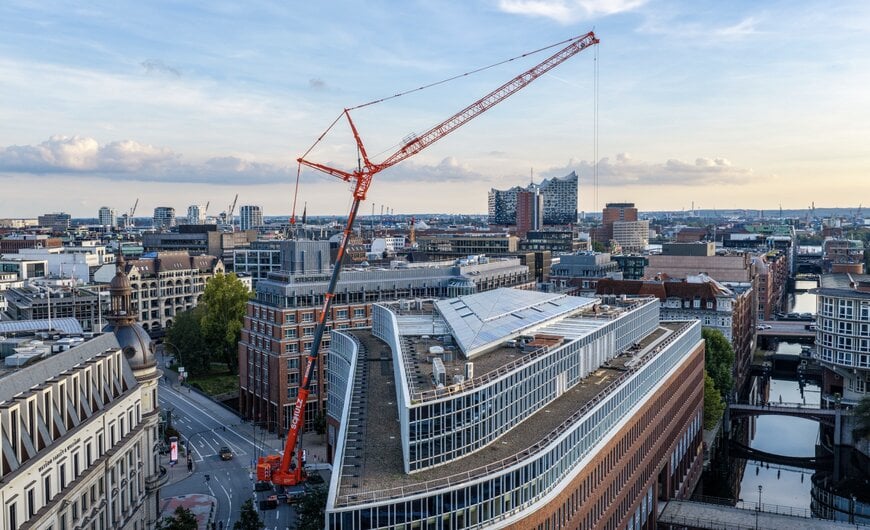
Lifting company Krandienst Schulz is collaborating with construction equipment manufacturer Liebherr to modernize and standardize its mobile crane fleet. This technical approach aims to facilitate the operational deployment of machines in constrained urban environments and to rationalize intervention planning on construction and industrial maintenance sites.
Standardization of Lifting Infrastructure
In the heavy lifting sector, equipment diversity can generate operational inefficiencies. By relying exclusively on a single supplier, Krandienst Schulz is implementing a standardized fleet approach. In 2026, the company integrated six new Liebherr mobile cranes, including the LTM 1150-5.4 and LTM 1400-6.1 models. This technical standardization is based on a common control philosophy across all the brand's machines.
This uniformity in control interfaces and onboard management systems allows for greater flexibility in operator assignment. A crane operator trained on the Liebherr operating system can transition from one machine to another with a reduced learning curve, which simplifies human resource scheduling and ongoing training. Additionally, centralized fleet management is facilitated by the use of the MyLiebherr digital customer portal, which allows for order tracking and predictive maintenance.
The collaboration is also backed by structured technical support. Spare parts availability and continuous technical assistance are decisive factors in minimizing machine downtimes, particularly during critical or night-time operations.
Intervention Engineering in Constrained Environments
The deployment of this new equipment primarily targets complex lifting operations in dense urban environments and industrial sites. The technical architecture of the cranes, notably their lifting capacity and reach, is leveraged for maneuvers requiring high precision.
A concrete application of this collaboration was carried out in early October 2026 during the replacement of heat exchangers for an air conditioning system at the Fleethof, located in the city center of Hamburg. This operation utilized the LTM 1400-6.1 model, a crane with a nominal capacity of 400 tonnes. The machine was configured with a luffing jib to achieve a reach of 55 meters.
The intervention presented several technical challenges. The components, with a unit mass reaching 3.5 tonnes, were embedded in the building's substructure. Operators had to rotate the suspended load to extract it while clearing a high building edge that required the use of the long reach. Furthermore, the crane's footprint had to be minimized, as the partial continuation of road traffic limited the available space for erecting and stabilizing the machine.
Edited by Aishwarya Mambet, Induportals Editor, with AI assistance.
www.liebherr.com
