
constructionequipmentmag.com
03
'26
Written on Modified on
Liebherr Launches the Electric R 9300 G8-E Mining Excavator
Delivering diesel-equivalent productivity with zero direct exhaust emissions, advanced smart assistance systems, lower operating costs, and enhanced operator comfort for modern sustainable mining operations worldwide.
www.liebherr.com
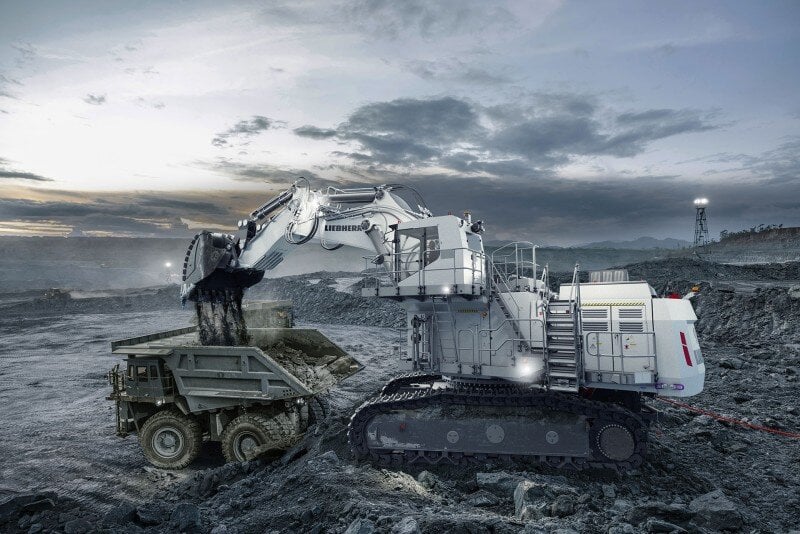
Open-pit mining operations face mounting operational and regulatory pressures to decarbonize extraction fleets without compromising digging cycle times or payload targets. In high-tonnage extraction, transitioning from internal combustion systems to electrified mobile plant addresses substantial diesel burn rates and localized exhaust exposure in deep pit environments.
Engineering Architecture and Drivetrain Electrification
The machine adapts the established Generation 8 mechanical platform by replacing the conventional diesel engine with an 850 kW electric drivetrain built in compliance with International Electrotechnical Commission (IEC) standards. Designed for high-voltage surface networks, the drive system operates on either 6 kV or 6.6 kV infrastructure, supplying direct electrical power to the primary hydraulic pump array.
This direct-electric conversion preserves the baseline production capacity of its diesel equivalent. At an assumed material density of 1.8 metric tons per cubic meter, the machine matches the hydraulic output and nominal bucket capacity of the standard diesel model. Validation testing has confirmed mechanical equivalence across both backhoe and face shovel digging attachments.
Hydraulic Control and Digital Assistance Systems
To optimize energy consumption across variable loading cycles, the machine incorporates Liebherr Power Efficiency – Hydraulic Control (LPE) as standard equipment. This closed-loop hydraulic control strategy continuously monitors operational load resistance and modulates fluid flow to match dynamic digging forces, which curtails parasitic hydraulic losses and limits overall drivetrain loading.
Digital integration relies on the Generation 8 electronic architecture, connecting the machine to the IoMine surface mining ecosystem. The onboard architecture supports semi-autonomous operating functions, including the Bucket Filling Assistant to regulate boom and arm trajectories during penetration, the Skyview situational vision system to mitigate blind spots around the counterweight radius, and Data View for telematics and cycle analysis. To maintain bench mobility without damaging trailing power cables, the unit can be equipped with an autonomous cable reel management system.
Operational Impacts and Maintenance Profiles
Operating an electric drive fundamentally alters maintenance overhead and cabin ergonomics. By eliminating combustion cylinder heads, fuel injection rails, exhaust aftertreatment hardware, and engine lubricants, the simplified rotating drivetrain decreases scheduled mechanical servicing intervals and cuts consumable disposal costs.
At the point of extraction, the zero-emission electric powertrain eliminates carbon monoxide and nitrous oxide discharge, which is critical in constrained bench cuts where air circulation is restricted. Removing the reciprocating mass of a multi-cylinder diesel block also dampens low-frequency vibrations transferred to the operator compartment, reducing structural cab fatigue.
Additional Context
This section details technical specifications and competitive benchmarking not included in the original product announcement.
In the 250- to 300-metric-ton operating class, electric mining excavators typically integrate high-voltage trailing cable infrastructure connected to mobile substations, distinguishing them from battery-electric prototypes that face gravimetric energy density limitations during sustained, multi-shift loading. The R 9300 platform features a nominal operating weight of approximately 250 metric tons and accommodates bucket volumes ranging from 14.5 to 16.5 cubic meters, positioning it to load 100- to 150-metric-ton haul trucks in four to five passes.
Direct benchmarks in the electrified 250- to 300-ton class include the Komatsu PC3000-11E, which employs a 900 kW drive motor at 6 kV to 6.6 kV, and equivalent cable-electric excavators from Caterpillar. While electric machines reduce per-hour energy costs compared to diesel machines, their operational envelope is constrained by trailing cable radius, power feed infrastructure, and bench advance logistics.
Edited by Evgeny Churilov, Induportals Media - Adapted by AI.
www.liebherr.com
