
constructionequipmentmag.com
21
'22
Written on Modified on
BACKHOLE EXCAVATOR HISTORY
The backhoe excavator is an industrial and mechanical machine that is used to make large excavations in all types of terrain. It has a bucket for digging located at the end of an articulated arm in two different parts.
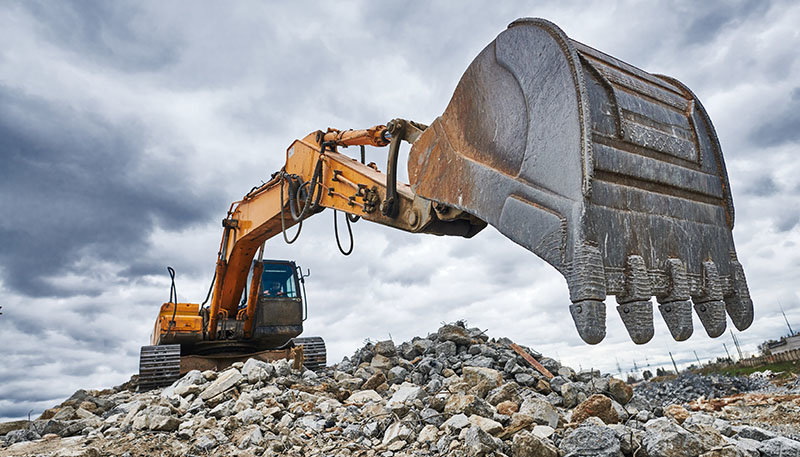
The backhoes are used for the excavation of earth and also for different types of openings of trenches for the laying of pipes and drains. In short, it is used to make deep holes that will then be filled back in, for example, house and building foundations. They are very used in general construction for the speed and quality of the work they provide. In the demolition of buildings, was used to break the asphalt of the streets and thus achieve an adequate process of paving in large and small cities. They are widely used in places where the use of other equipment is not practically useful. In addition, they are a precise source of cost reduction and time saving in the different works they are used for.
- It consists of a three piece assembly of earth moving equipment: a tractor, a charger and a backhoe.
- The assembly allows the tools to move quickly and safely.
- You can transport large quantities of material depending on the container size.
- It is primarily designed to dig earth.
- The container where the material is deposited is known as the bucket.
- The backhoe in itself has three parts: the bucket, the stick and the boom.
- It is also known by the name of mechanical shovel.
In the year 1950, the well-known caterpillar tractor was used in the area of construction. This instrument has proved to be a very useful however; company experts were looking for ways to increase its usefulness, efficiency and versatility. At that time the Essex Company located in England known by the name of Whitlock Bros, assured their clients and to rest of the world, it had succeeded in creating the world’s first backhoe. The company had created an accessory called Dinjum Digger, and conducted a series of experiments in the year 1951. Some time later, the company incorporated a hydraulic loader creating in this way, the first backhoe loader. Joseph Cyril Bamford, was the founder of the company JCB and he had great experience in the construction of the hydraulic loaders. On a trip to Norway he noted the great potential of the backhoe and bought one to take back to where he lived to try out its capabilities.
By the year 1953, he had managed to improve the design and had built the first accessories included on the machine. He manufactured the product as the JCB MK1 and in 1958; he was able to launch the first integrated backhoe onto the market.
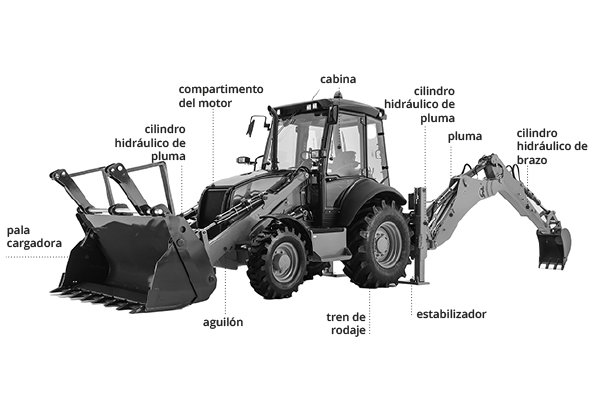
Types and the parts of the backhoe excavator
The parties that make up a backhoe are:
By the year 1953, he had managed to improve the design and had built the first accessories included on the machine. He manufactured the product as the JCB MK1 and in 1958; he was able to launch the first integrated backhoe onto the market.
Types and the parts of the backhoe excavator
The parties that make up a backhoe are:
- Point of union between the stick and the boom.
- Hydraulic Cylinder Bucket
- Chain link joint.
- Undercarriage.
- Chassis or frame.
- The engine compartment.
- Operator’s cab.
- Boom or stick hydraulic cylinders.
- Pen or boom.
- Hydraulic cylinder arm.
Bucket excavators are also known with the name of mechanical shovels or mechanical diggers. They are used for vertical excavations in the production of wells and in mining. They can go on tires or be mounted on tracks and have the ability to turn up to 360º on themselves with the help of an axis.
Another type of backhoes is the hydraulic excavator. The price is more accessible and its power is the same. In contrast to mechanical shovels, they work in the field from top to bottom and are much faster at loading material. The blade carries the bucket high and it can unload from a greater height. It is used mostly in mining.
www.blumaq.com
Another type of backhoes is the hydraulic excavator. The price is more accessible and its power is the same. In contrast to mechanical shovels, they work in the field from top to bottom and are much faster at loading material. The blade carries the bucket high and it can unload from a greater height. It is used mostly in mining.
www.blumaq.com
