
constructionequipmentmag.com
03
'26
Written on Modified on
Optimizing structural development and autonomous systems in crawler excavators
Liebherr France SAS has commissioned an advanced validation test rig at its Colmar facility. The system accelerates structural stress testing and serves as a deployment platform for autonomous machine software.
www.liebherr.com
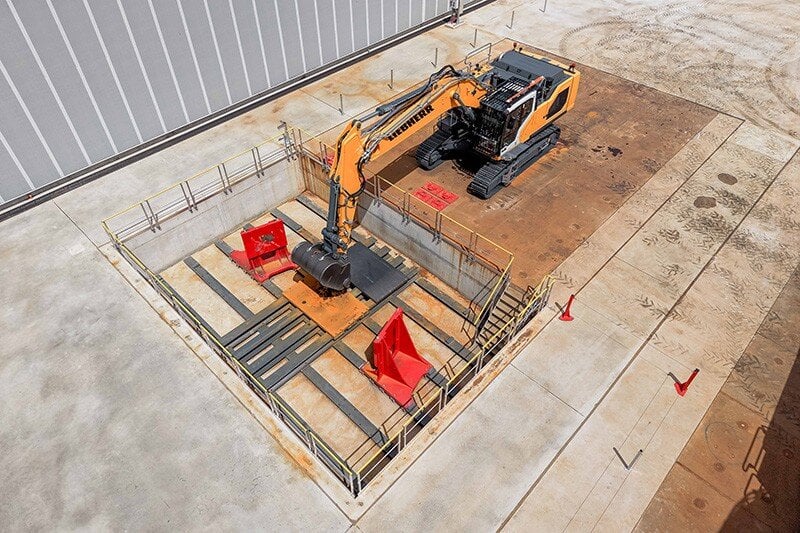
Industrial machinery destined for earthmoving applications encounters severe structural stresses, including multi-axial vibrations, torsional forces, dynamic impacts, and bending moments. Evaluating the long-term impact of these forces under real-world operating conditions typically requires thousands of hours of field tracking, which delays product development cycles. To optimize structural reliability, a localized testing infrastructure is required to simulate accelerated mechanical aging within controlled parameters.
The newly deployed test bench provides an operational acceleration coefficient of 17, compressing 17 hours of actual field stress into a single hour of automated testing. The physical infrastructure includes an integrated test track and a specialized trench housed within an enclosed hall. Environmental noise compliance is maintained by a concrete retaining wall equipped with six-meter-high acoustic barriers, isolating the high-impact vibrations from the surrounding industrial estate.
Autonomous Operation and Digital Safety Infrastructure
To execute the repetitive duty cycles required for comprehensive structural analysis, the test engineering teams integrated autonomous driving systems into the testing fleet. This configuration removes human operators from hazardous high-stress environments and allows continuous data collection without physical intervention. System control and technical telemetry are managed remotely from a centralized external control room using an integrated optical camera matrix.
The system architectural safety profile relies on an integrated, multi-layered digital and physical infrastructure. Physical gate locks and electronic access door contacts prevent unauthorized entry into the testing zone. Dynamically, laser sensors scan the perimeter for obstructions, while high-precision GPS tracking modules enforce digital geofencing. If a machine deviates from its pre-mapped spatial coordinate matrix, the control loop automatically triggers a fail-safe system shutdown.
Data Interoperability and Local Integration
The testing profiles are synthesized from empirical load data acquired during real-world operations across diverse customer deployment sites. This field data is converted into automated execution scripts to ensure high reproducibility of mechanical stress factors. The engineering team utilizes these reproducible datasets to identify structural weak points early in the prototyping phase, significantly shortening the loop between defect identification and component modification.
The physical construction of the facility spanned sixteen months, comprising nine months of engineering design and seven months of civil works. To ensure high geometric tolerance and material compatibility, Liebherr manufactured the core mechanical steel assemblies internally using the facility's existing production infrastructure. The localized alignment of design engineering, steel fabrication, and autonomous validation accelerates the development pipeline for next-generation heavy machinery.
Edited by Sucithra Mani, Induportals editor – adapted by AI.
www.liebherr.com
