
constructionequipmentmag.com
04
'26
Written on Modified on
Efficient Excavator Tool Integration Through Standardization
Liebherr integrates the MiC 4.0 BUS into its wheeled excavator generation to optimize attachment management.
www.liebherr.com
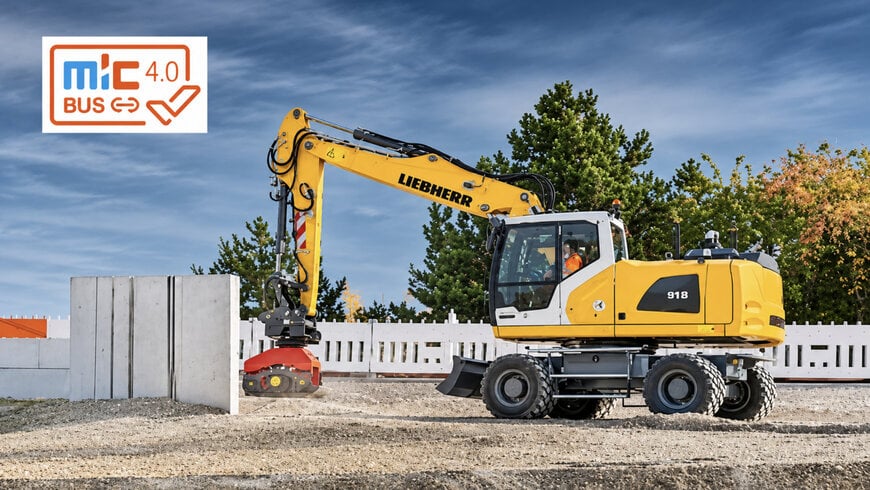
On modern construction sites, the increasing complexity of hydraulic and mechanical tools requires standardized digital interfaces to minimize setup times and automate operational workflows. To address these industrial challenges, the Liebherr Group is expanding the connectivity of its eighth-generation wheeled excavators to include the cross-manufacturer communication standard MiC 4.0 BUS. This technology enables automated data exchange between the host machine and its attachments, optimizing the integration of specialized tools into existing site operations.
Machine Process Integration and Operating Principle
The MiC 4.0 BUS relies on a standardized CAN-based network adhering to SAE J1939, connecting the machine control system directly with compatible attachments. As soon as a matching tool is coupled, the system automatically transmits device-specific parameters such as the tool type, serial number, operating pressure, and flow rate to the excavator. Manual inputs by the machine operator are largely eliminated, reducing error rates during the commissioning of complex tools like tiltrotators or grapples. This automated matching also ensures that safety-relevant functions, such as working range limitations, are precisely adjusted to the respective attachment.
Technical Specifications and System Architecture
The physical and protocol-level specifications of the MiC 4.0 BUS follow fixed industrial standards. The transmission protocol utilizes a CAN bitrate of 250 kbit/s in accordance with SAE J1939-15 using unshielded twisted-pair cables. A standardized 8-pin connector system serves as the physical interface. The network supports addressing up to three attachments simultaneously, with standardized source addresses defined in the range from 80h to F7h for different tool classes. Parameter groups are transmitted periodically to ensure low-latency and reliable regulation during ongoing operations.
Application Areas and Fleet Management
Integrating this standard relieves operators, particularly during frequent tool changes, and minimizes machine downtime. Beyond immediate site operations, the interface serves as the foundation for data-driven fleet management. Asset-specific utilization data, operating hours, and maintenance statuses are captured via the MiC 4.0 BUS and channeled into the MyLiebherr Maintenance & Performance customer portal. This enables predictive maintenance, increases equipment availability, and optimizes the overall economic efficiency of the machinery fleet. Furthermore, thanks to the cross-manufacturer approach, MiC 4.0-ready tools can be swapped flexibly between different carrier machines from various manufacturers.
Additional Context:
This section details technical specifications and competitive benchmarking aspects not included in the original product announcement.
The standardization of attachments in the construction machinery sector has emerged as a central industry trend over recent years to replace proprietary interfaces from individual manufacturers. Initiated by the VDMA (Mechanical Engineering Industry Association) and the German Construction Industry Federation (HDB), the MiC 4.0 working group addresses a long-standing technological gap, as traditional excavator interfaces previously required manual programming and individual parameterization. Compared to conventional, purely proprietary bus systems or analog controls, the open J1939-based approach of the MiC 4.0 BUS offers the advantage of standardized diagnostic capabilities via normalized on-board diagnostics (OBD) alongside defined fail-safe behavior through integrated terminating resistors. Although manufacturer-specific automation solutions occasionally existed within closed ecosystems, a cross-manufacturer standard enabling brand-independent attachment operation at the same technical level was previously missing. Regulatory compliance, particularly regarding CE certification and machinery safety during retrofitting, is significantly facilitated by factory-integrated standardized bus interfaces such as those in Liebherr's Generation 8 wheeled excavators.
Edited by Sucithra Mani, Induportals editor – adapted by AI.
www.liebherr.com
